
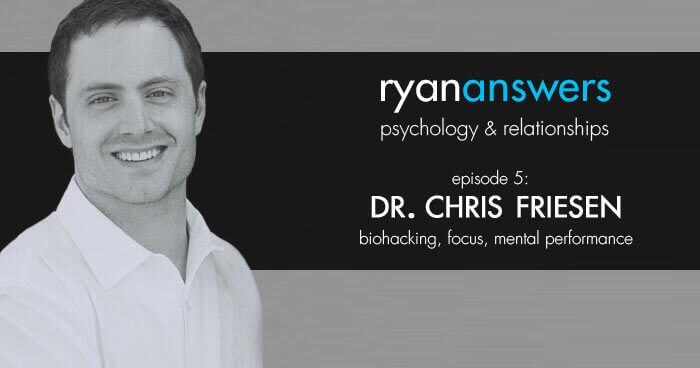
We’re back! For those who don’t know, I took a 6 month break to relocate across the country. I’ve interviewed some incredible guests since moving to the Toronto area, and one person I was fortunate enough to meet is Dr. Chris Friesen.
He works with Olympic athletes, pro athletes, CEOs, entrepreneurs, and other high achievers to maximize their performance. Today, he shares the keys to success, and answers the questions you sent in last week.
In This Episode You’ll Learn About:
2:45 – Listener question: How does the brain’s dark energy effect sports performance?
3:20 – The secret to getting into “the zone”
5:00 – The keys to mental focus
7:10 – Learn which types of brain waves result in the best performance, and how you can measure them
9:45 – Listener question: How do you deal with adrenaline dumps and high pressure situations?
11:45 – Why being too calm is actually bad for performance (this one surprised me)
15:00 – How fighting your thoughts only makes them worse
17:25 – Biohacking your anxiety to de-stress
27:30 – Doctors were stumped… learn the simple biohack than can cure stomach problems
29:00 – Staying focused and being true to your values in the age of constant distraction
33:00 – The one major mental mistake that sabotages your ability to achieve
Listen to Episode 5: Dr. Chris Friesen on Biohacking, Focus, and Mental Performance
Download this episode as an MP3 here
Listen to it on iTunes

It’s been 7 years now. More than 1,000 people. And through it all, there has been a consistent pattern in all the couples I’ve seen.
The pattern is simple – three things that are easy, free, and have an instant impact on your relationship.
No more excuses! Take the advice in this post and I promise you’ll see immediate results.
1) Go To Bed Together
If you aren’t going to bed together, you’re missing out on one of the best ways to connect. I know sometimes people have different sleep schedules, and it can be frustrating for both of you. If you commit to doing this, your schedules sync up and it becomes second nature.
As a general rule, join your partner within 30 minutes of them going to bed. But what about couples that work opposite, or very different hours?
If you’re the one who stays up late, go to bed with your partner until they fall asleep. Bed is one of the few times you have privacy and the chance to be intimate (both sexually and emotionally) so it’s important not to skip out. On top of that, it can be hard to fall asleep before your partner joins you.
Falling asleep alone has this weird exaggerated mental effect. People who fall asleep alone tend to report feeling more alone and unsupported in the relationship, even if they aren’t. I’m not a neuroscientist, but it wouldn’t surprise me if we’re hard wired on some level to crave closeness at night, and to feel more isolated than usual if we don’t have it.
2) No Electronics In Bed!
Creeping around on your phone is a bedtime ritual for many people, and it’s absolutely horrible for your relationship. It totally defeats the purpose of going to bed together.
I get that for some people it’s a way to unwind, and that’s cool – just do it *before* bed. Scroll through your feed, catch up on sports, read forums, do whatever you want as long as it’s not in the bedroom. When you’re done, put your phone on silent and leave it under your pillow or on your bedside table (facedown).
This goes for TV as well. And if you aren’t sold on the relationship benefits, consider that your brain forms associations between things very easily. It won’t secrete as much melatonin (sleep chemical) if it doesn’t think you’re going to your sleeping spot.
You have to train your brain to associate your bedroom with sleep… and sex! But watching TV and creeping your phone are definitely not associations you want to build.
3) Spend At Least 1 Hour a Week Dating
The vast, vast majority (I’d say 90%+) of couples I see don’t even spend an hour a week together doing stuff.
You don’t need to be going out for fancy dinners, expensive outings, or extravagant locations, a simple picnic in the park is enough. The key here isn’t so much what you’re doing, but that you’re doing it together with no interruptions.
If you have kids, get a sitter. Turn your phones off. I don’t care if you use your phone for work or if you’re on call. If you can’t be away from your phone for an hour, you’re lying to yourself about how important you are and disrespecting your spouse at the same time. Period.
Ride bikes together. Get some gelato and go for a stroll downtown. See a fortune teller, even if you know it’s a bunch of BS. Halloween is coming up… grab a latte and go pick pumpkins together.
Have Your Own Tips?
Have your own date ideas? Tips that have helped out your relationship? I’d love to hear about them! Post a comment below the article, and subscribe to my weekly email for free dating and relationship tips!

A while ago I wrote an article on the causes of cheating.
The main thing I wanted to get across was that, overwhelmingly, insecurity is the root cause of cheating.
Understandably, a couple of commenters disagreed with me. The source of our disagreement is something pretty simple.
In psychology, there are two causes of behaviour. There’s immediate causes (proximate) and “deeper causes” (ultimate).
The Two Causes of Behaviour
Say a ship sinks. You could say it went down because too much water got into the hull, and you’d be right. This is an immediate, or proximate cause.
You could also say it went down because the captain wasn’t paying attention, or the spotter was busy watching people make out, or whatever. You’d still be right. This would be the ultimate cause.
Insecurity is often an ultimate cause of cheating, but almost always a proximate cause.
I should’ve done a better job at explaining the whole proximate / ultimate thing in my last article. My bad.
A secure person with a good support system of friends and family, separate interests and activities, and a stable sense of self is more likely to leave a relationship than cheat.
If you have no where to go, no one to talk to, nothing you can do to clear your head and socialize with other people, and so on, leaving a relationship becomes waaaay more difficult.
This is what I was talking about when I said cheating is about unmet personal needs, not unmet relationship needs.
It’s pretty common for people to fulfil their personal needs with their relationship. The needs you’re responsible for fulfilling outside the relationship and the needs your relationship should fulfil become all mixed up.
It’s Like Jenga
Like most people, I’m a visual learner. This will make a lot more sense with a picture, so here’s a visual version of what your needs look like:

If you look at the yellow bar, you’ll see friendship, family, intimacy. That’s where relationship needs fit in.
Imagine each coloured bar is divided into separate blocks, like Jenga. Leaving a relationship that provides you with intimacy would be like pulling out one of the blocks. There’d be a hole, but the tower would remain standing.
If you have your personal needs fulfilled, this is exactly what would happen.
When you don’t have your personal needs fulfilled, the little “intimacy” block in the middle isn’t so little anymore. Suddenly your relationship now represents the entire yellow bar, maybe chunks of the orange bar, and some of the green bar too.
If you pull all that out, well… the whole thing crumbles. Even if a relationship isn’t “meeting your needs”, it’s still fulfilling a bunch of your personal needs. You can’t end the relationship without tearing yourself apart.
When I say insecurity and unmet personal needs are the cause of cheating, that’s what I’m talking about.
There might be deeper, ultimate causes, but eventually you’ll run into the proximate cause of not leaving the relationship to resolve things in a healthy way.
Hope that provides some more clarity. If you still disagree with me, though (d’oh…) I’m interested in hearing what you have to say.
Every couple fights. You know what’s crazy though?
On average, couples remain unhappy for a few years before they seek a therapist. YEARS.
It gets to the point where every conversation is an argument.
After the constant arguing phase is the quiet phase. Tired of arguing, both people give up on communication altogether.
Eventually, things get so bad that people *gasp* call a counsellor.
I’ve always found that funny. The average person thinks couples counselling is going to be so awful that they’d rather endure years of frustration and emotional pain.
We need to change the perception of counselling somehow, maybe if a bunch of us started doing sessions at the local bar instead of an office.
“If therapy doesn’t work, just get wasted!”
Problem Solve Like a Therapist
Sometimes relationships die a long, slow death.
It seems like nothing happened, but stuff went wrong… a whole lotta small stuff that went under the radar.
Chemistry seems to fade, intimacy isn’t there, arguing is almost constant, and you can’t figure out why.
Start by asking yourself some questions, and look for any common factors.
When do you argue? What do you argue about? Are there any people that seem to trigger arguing?
Where do you argue? This is a big one most people neglect.
When is the last time you had sex? What about a fun date? Uninterrupted time to just hang out?
Sometimes you can throw the psychology out and go back to basics. If you’re doing the basics but still have trouble getting through a conversation, it’s time to dig a bit deeper.
Put On Your Psychology Hat
Now the fun part. Do your best Sigmund Freud impression, but probably leave out the cocaine. Yes, the father of psychology was an addict (he found cocaine useful for talk therapy).
Chances are you’re already decent at understanding people and communicating. If you’re arguing lots, the problem you’re probably having is caused by your partner’s psychological defence system.
With awareness and a bit of skill, you can neutralize their defence and move the conversation forward.
How Does the Mind’s Defence Work?
You know the feeling when someone disproves your point but you still want to argue?
That’s the ego protecting your ass from the feeling of being wrong.
Sometimes, an issue triggers ego defenses and prevents conversation altogether. If you’re constantly arguing, this is exactly what’s happening.
Avoid the Triggers, Avoid the Argument
You don’t need to change your message to avoid triggers, it just has to be “packaged” so they aren’t scared, threatened, or hurt by what you’re saying.
This comes down to one thing.
Don’t Talk About Your Partner.
Don’t tell them what they did, what they need, what they need to change, or anything. Talk about you.
Most people fall into the trap of needing their perspective to be accepted before moving forward.
The truth is, both of your perspectives are “right”.
Stop obsessing over what they did. Start focusing on your experience.
BAD: You lied because you aren’t big enough to tell the truth. If you can’t admit that we have nothing to talk about.
GOOD: I felt hurt because XYZ happened again and you said it wouldn’t. When I feel hurt it makes me scared to open up to you. What makes you want to be dishonest with me?
You explain your experience without judging or insulting, you clearly communicate the problem, and you create a safe scenario for them to move the conversation forward.
Basically, it’s a simple formula for taking all the prickly bits out of the conversation. Once you do that, you’ve removed the biggest roadblock to resolving the root issues.
If you’re still having trouble and want free advice, subscribe here.

 No, I haven’t died. Although you’d be forgiven for thinking so after looking at the date on recent posts.
I have relocated my relationship and couples counselling practice from Edmonton, Alberta to Hamilton, Ontario. It was a thankfully uneventful 3,500 kilometre drive from one side of Canada to the other, aside from a speeding ticket and a few animal sightings.
Counselling is still available to Edmonton and area clients via phone and Skype, and occasional visits in person.
As of now, I’m available for housecalls in the Burlington, Hamilton, and Grimsby areas.
Posting schedule is also back to normal – articles on Tuesdays, podcasts on Wednesdays, and videos on Thursdays.
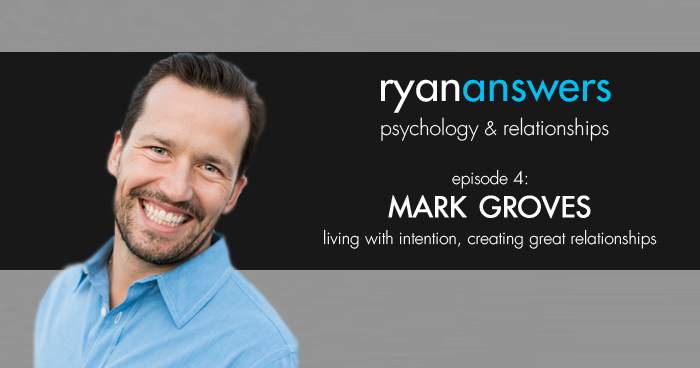
Mark and I had some great conversations around taking ownership of your life. Most people operate on autopilot, and haven’t done what Mark calls a life audit.
In This Episode You’ll Learn About:
3:00 – “Waking up” to your life
6:00 – The 3 questions to ask before marriage
9:30 – Operating on “Catholic Autopilot”
10:40 – Why we resist “waking up”
16:00 – Auditing your Life
22:20 – Making positives out of negatives
24:20 – Redefining success in relationships
30:00 – Relationship bids, and why missing them is dangerous
32:40 – How to handle changing relationship priorities
36:45 – When do you have tough conversations
46:20 – Avoiding information overload and taking action
48:45 – Dealing with criticism when you try to change
51:45 – Handling the most important relationship of all
57:00 – Brains scans of people in marriage vs new relationships
59:30 – The importance of doing new things with your partner
Listen to Episode 4: Mark Groves on Living Intentionally and Creating Great Relationships:
Download this episode as an MP3 here
Listen to it on iTunes.
Links and topics from the episode:
1) Mark’s website can be found here. He posts new articles, videos, and answers your questions often! He has a podcast called “Just the Tip” (hahaha perfect name) coming out in April 2015.
2) Info on the AMAZING singles and couples retreats can be found here.
The mailbag is a Q&A column based on the emails you guys send me. If you have a question related to dating, relationships, or psychology, click here to send me your question and your email might be the next one chosen.
How Do I Be Authentic With New People?
Hi Ryan, okay so I’ve been thinking about the question you posed and I’ve come up with this.
Since my last dating relationship ended, I must say that my biggest challenge I find myself dealing with is being my true authentic self when I meet new people. I guess you could say I have trouble being vulnerable and 100% honest about my thoughts and feelings.
And trust me over the past couple of months I have been telling myself that I want to challenge myself and open space for vulnerability because I do believe that although scary it is essential in any given relationship yet I am not sure how to get there.
I am currently not dating anybody but I am wondering how to face this challenge the next time someone new comes around? I think this is a scary thought because at the end of the day being vulnerable also brings the fear of “will I be good enough?” (I know I know what is good enough anyway, yet it’s a fear that creeps in).
My Answer:
You’re not the first person to tell me they have trouble being 100% authentic with new people. That you’re experiencing this doesn’t worry me at all.
What worries me is the authenticity mantra that’s preached nowadays is getting out of hand. It’s totally and completely acceptable to be guarded when you first meet people. In fact, I would say it’s a good thing.
I would say you have healthy boundaries. As you get to know someone, you can choose to let them become closer to you or decide that they aren’t someone you want to know more intimately. Not everyone you meet deserves your total honesty.
People who are emotionally vomit on new friends are usually the ones who have issues with “always meeting the wrong people”. They let everyone in and get burned often. On top of that, perceptive people recognize this person’s lack of boundaries, and this naturally filters out the “right people”.
People who are emotionally closed off to new friends are usually the ones who don’t meet anyone. Their filter is too tight and no one gets in.
You sound like you’re one of the people in the middle. You can filter out the people who are untrustworthy. The people who make it through your filter are worth opening up to, so take a chance with them.
As for being good enough, the only person you need to satisfy is yourself. If you’ve never thought about it, ask yourself what you admire in others. What standards do people have to meet before you consider them good enough?
If you meet those, you’re doing great.
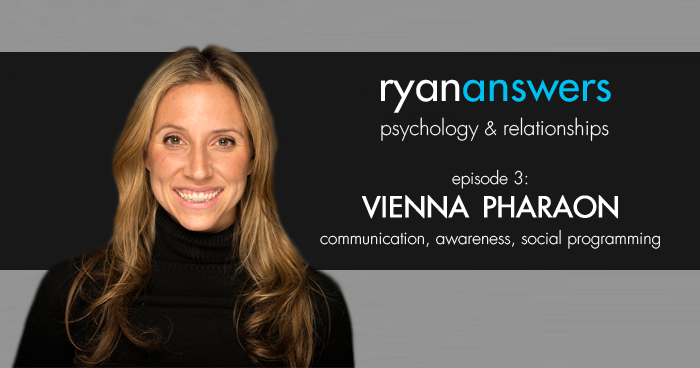
With the help of some AMAZING guests, the podcast thing is really taking off. Today we go deep into the core of relationship communication, and how to leverage the relationship psychology most people don’t know about.
Vienna tells you how to recognize signposts exposing subconscious fears, how to avoid conflicts by understanding your partners love map, and LOTS more.
Episode Guide:
1:20 – Physical Fitness and Mental Health
5:30 – The Communication Mistake That Kills Couples
9:00 – How Your Family Affects Your Communication Style
15:20 – The Importance of Partner Awareness and Stories
18:00 – Why You’re Drawn to the Wrong People Over and Over (I LOVED this part!)
22:30 – Keys to Connecting Deeper
26:00 – How to Remain Open to Love After Being Burned
29:00 – Do Your Fears Undermine Your Relationships?
32:45 – If You Haven’t Done This, You’re Not Self-Aware
36:00 – How the Best Couples Help Each Other Grow
38:25 – The Easy Way to Expose Your Subconscious Insecurities
40:20 – What Rabbits Teach Us About Relationships
43:00 – Replace Criticism with Curiosity
45:00 – Relationship Communication Quick Tips
51:00 – The Danger Of Relationship Quick Fixes
Listen to Episode 3: Vienna Pharaon on Communication, Awareness, and Social Programming
Download this episode as an MP3 here
Listen to it on iTunes.
Links and topics from the episode:
Some GREAT quotes from Vienna today:
“The words spoken to us become our inner dialogue with ourselves.”
“Every single one of us started in a place where someone else was telling us about ourselves, about what we
should believe.”
“We’re programmed to listen to other people tell us about ourselves.”
“Replace criticism with curiosity.”
1) Vienna’s site can be found here.
2) Info on the singles retreat (yoga, personal chef, California beaches!!) can be found here.
3) Vienna’s Instagram page with almost 20,000 (!!!) followers can be found here.

